
Comparative Effectiveness of Endoscopic Sinus Surgery Versus Medical Therapy on Olfactory Function in Chronic Rhinosinusitis: A Systematic Review and Meta-Analysis
DOI:
https://doi.org/10.33192/smj.v78i10.283458Keywords:
chronic rhinosinusitis, endoscopic sinus surgery, medical therapy, olfactory dysfunction, meta-analysisAbstract
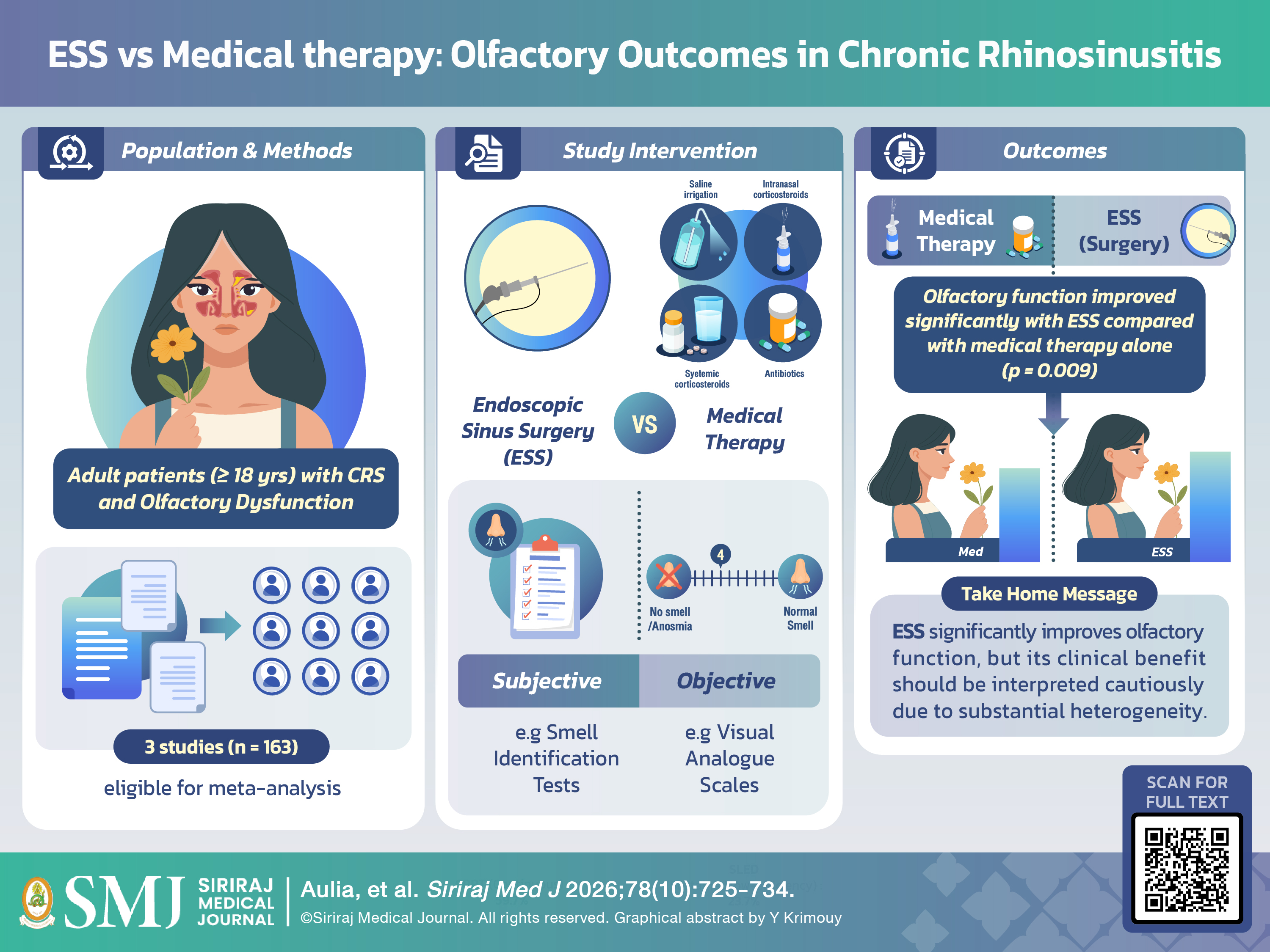
Objective: This study aimed to compare the effectiveness of ESS versus medical therapy in improving olfactory function among adult patients with CRS.
Materials and Methods: A systematic review and meta-analysis were conducted using PubMed, Cochrane Library, and ScienceDirect. Comparative studies evaluating ESS and medical therapy with reported olfactory outcomes were included. Standardized mean differences (SMD) were calculated using a random-effects model. Outcomes were orientated such that higher values indicated better olfactory function.
Results: Four studies were included in the qualitative synthesis, with three studies (n = 163) eligible for quantitative meta-analysis. The pooled analysis demonstrated a statistically significant improvement favoring ESS over medical therapy alone (SMD = 1.02, 95% CI: 0.26 to 1.78; p = 0.009), though substantial statistical heterogeneity was observed (I² = 75%). Individual studies showed variable results across outcome metrics. Despite this statistical difference, the differences between objective psychophysical testing and subjective self-reported measures.
Conclusion: Evidence regarding the comparative effectiveness of ESS versus medical therapy in improving olfactory function remains highly uncertain. Given the methodological limitations of current data, further high-quality, well-phenotyped trials are required to clarify relative treatment efficacy.
References
Rombaux P, Huart C, Levie P, Cingi C, Hummel T. Olfaction in Chronic Rhinosinusitis. Curr Allergy Asthma Rep. 2016;16(5):41.
Soler ZM, Hyer JM, Ramakrishnan V, Smith TL, Mace J, Rudmik L, et al. Identification of chronic rhinosinusitis phenotypes using cluster analysis. Int Forum Allergy Rhinol. 2015;5(5):399–407.
Yang SK, Cho S-H, Kim DW. Interpretation of Clinical Efficacy of Biologics in Chronic Rhinosinusitis With Nasal Polyps via Understanding the Local and Systemic Pathomechanisms. Allergy Asthma Immunol Res. 2022;14(5):465.
Rimmer RA, Mace JC, Gill A, Alt J, Detwiller K, Geltzeiler M, et al. Association of statins with quality of life and olfaction in patients with chronic rhinosinusitis. Int Forum Allergy Rhinol. 2022;12(2):237–9.
Oleszkiewicz A, Schriever VA, Croy I, Hähner A, Hummel T. Updated Sniffin’ Sticks normative data based on an extended sample of 9139 subjects. Eur Arch Otorhinolaryngol. 2019;276(3):719–28.
Orlandi RR, Kingdom TT, Smith TL, Bleier B, DeConde A, Luong AU, et al. International consensus statement on allergy and rhinology: rhinosinusitis 2021. Int Forum Allergy Rhinol. 2021;11(3):213–739.
Hummel T, Whitcroft KL, Andrews P, Altundag A, Cinghi C, Costanzo RM, et al. Position paper on olfactory dysfunction. Rhinol Suppl. 2017;54(26):1–30.
Michalik M, Krawczyk B. Chronic Rhinosinusitis—Microbiological Etiology, Potential Genetic Markers, and Diagnosis. Int J Mol Sci. 2024;25(6):3201.
Hopkins C. Chronic Rhinosinusitis with Nasal Polyps. N Engl J Med. 2019;381(1):55–63.
Benninger MS, Sindwani R, Holy CE, Hopkins C. Early versus Delayed Endoscopic Sinus Surgery in Patients with Chronic Rhinosinusitis. Otolaryngol Head Neck Surg. 2015;152(3):546–52.
Smith TL, Kern RC, Palmer JN, Schlosser RJ, Chandra RK, Chiu AG, et al. Medical therapy vs surgery for chronic rhinosinusitis: a prospective, multi‐institutional study. Int Forum Allergy Rhinol. 2011;1(4):235–41.
Zhang J, Sima Y, Shao S, Zheng M, Zhao Y, Gao F, et al. Cost-utility and clinical outcome analysis of surgery or oral corticosteroids treatment in patients with chronic rhinosinusitis with nasal polyps. Asia Pac Allergy. 2024;14(4):174–82.
DeConde AS, Mace JC, Alt JA, Schlosser RJ, Smith TL, Soler ZM. Comparative effectiveness of medical and surgical therapy on olfaction in chronic rhinosinusitis: a prospective, multi‐institutional study. Int Forum Allergy Rhinol. 2014;4(9):725–33.
Ragab SM, Lund VJ, Scadding G. Evaluation of the Medical and Surgical Treatment Of Chronic Rhinosinusitis: A Prospective, Randomised, Controlled Trial. Laryngoscope. 2004;114(5):923–30.
Zhu H, Qu S, Gong M, Xiang Y, Gan S, Teng Y, et al. Mechanisms, diagnosis, and treatment of olfactory dysfunction in rhinosinusitis. Eur J Med Res. 2025;30(1):474.
Lane AP, Mullol J, Hopkins C, Fokkens WJ, Lee SE, Msihid J, et al. Dupilumab improves sense of smell and clinical outcomes in patients with severe chronic rhinosinusitis with nasal polyps with anosmia. Curr Med Res Opin. 2025;41(1):53–9.
Kohli P, Naik AN, Farhood Z, Ong AA, Nguyen SA, Soler ZM, et al. Olfactory Outcomes after Endoscopic Sinus Surgery for Chronic Rhinosinusitis. Otolaryngol Head Neck Surg. 2016;155(6):936–48.
Hadi W, Sujana WIA. Osteitis in Chronic Rhinosinusitis: A State-of-the-Art Review. Siriraj Med J. 2025;77(7):533–42.
Hernandez AK, Wendler O, Mayr S, Iro H, Hummel T, Mueller SK. Predictors of olfactory improvement after endoscopic sinus surgery in chronic rhinosinusitis with nasal polyps. J Laryngol Otol. 2023;137(5):524–31.
Briner HR, Jones N, Simmen D. Olfaction after endoscopic sinus surgery: long-term results. Rhinology. 2012;50(2):178–84.
Additional Files
Published
How to Cite
License
Copyright (c) 2026 Siriraj Medical Journal

This work is licensed under a Creative Commons Attribution-NonCommercial-NoDerivatives 4.0 International License.
Authors who publish with this journal agree to the following conditions:
Copyright Transfer
In submitting a manuscript, the authors acknowledge that the work will become the copyrighted property of Siriraj Medical Journal upon publication.
License
Articles are licensed under a Creative Commons Attribution-NonCommercial-NoDerivatives 4.0 International License (CC BY-NC-ND 4.0). This license allows for the sharing of the work for non-commercial purposes with proper attribution to the authors and the journal. However, it does not permit modifications or the creation of derivative works.
Sharing and Access
Authors are encouraged to share their article on their personal or institutional websites and through other non-commercial platforms. Doing so can increase readership and citations.