
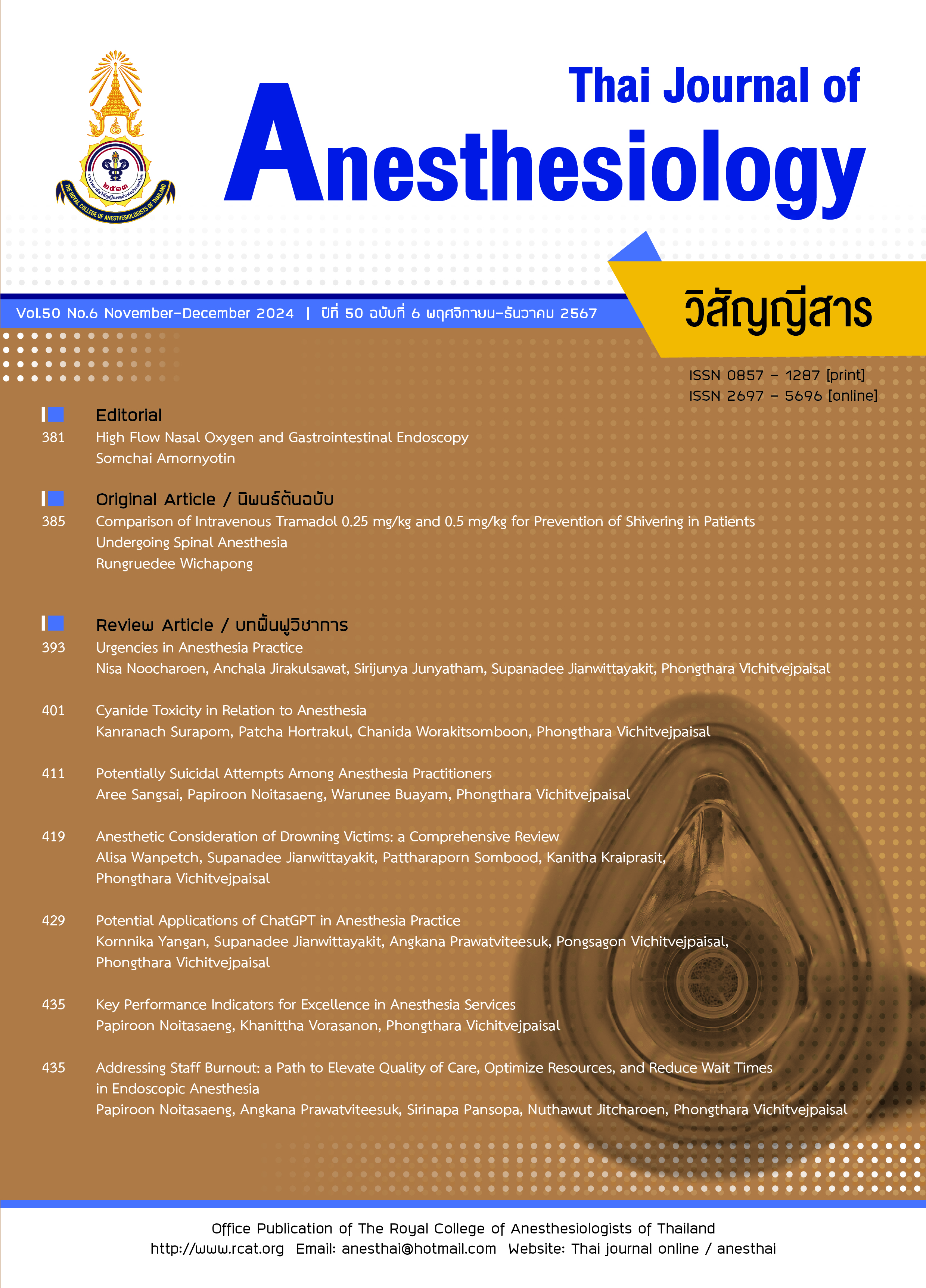
Key Performance Indicators for Excellence in Anesthesia Services
Keywords:
anesthesia service, healthcare quality improvement, key performance indicatorAbstract
This article delves into the crucial role of key performance indicators (KPIs) in optimizing anesthesia services within public healthcare systems. KPIs serve as indispensable tools for measuring and enhancing the quality, safety, efficiency, and sustainability of anesthesia care. The importance of KPIs is underscored by their ability to improve patient safety and the overall quality of anesthesia care, optimize resource allocation and cost-efficiency, support data- driven decision-making, and foster transparency and accountability in anesthesia practice. The article also explores emerging technologies such as internet of thing devices and predictive analytics, which are revolutionizing KPI monitoring in anesthesia. Additionally, it delves into evolving regulatory and accreditation standards that are shaping the future of anesthesia practice. Ethical considerations, potential pitfalls, and data quality issues associated with KPIs are carefully examined to ensure that the integration of KPIs in anesthesia services adheres to the highest ethical and data integrity standards.
Downloads
Published
How to Cite
Issue
Section
License

This work is licensed under a Creative Commons Attribution-NonCommercial-NoDerivatives 4.0 International License.
Copyright
Copyright of all articles published in the Thai Journal of Anesthesiology is held by the Thai Journal of Anesthesiology, the Royal College of Anesthesiologists of Thailand. Submission of a manuscript constitutes the authors' agreement that, upon acceptance for publication, copyright of the work is transferred to the Journal. The content and any opinions expressed in published articles are the sole responsibility of the authors and do not necessarily reflect the views of the editorial board or the Royal College of Anesthesiologists of Thailand.
Licensing
All articles are published open access under the Creative Commons Attribution-NonCommercial-NoDerivatives 4.0 International License (CC BY-NC-ND 4.0). Under this license, anyone may copy and redistribute published articles in any medium or format for non-commercial purposes, provided that appropriate credit is given to the authors and to the Thai Journal of Anesthesiology as the original source of publication, a link to the license is included, and the material is not modified in any way. Requests for commercial use or for adaptation of published material should be directed to the editorial office.
Authors' Rights
Although copyright is held by the Journal, authors retain the right to reuse their own published material in their future scholarly works, theses and dissertations, teaching, and academic presentations, and to deposit the final published version (PDF) in institutional or subject repositories or on personal and institutional websites, without embargo, provided that the Thai Journal of Anesthesiology is clearly acknowledged as the original place of publication.