
A Diagnosis-to-Surgery Interval Time of >30 Days Does Not Independently Predict Significantly Poorer Survival Outcomes in Thai Patients with Non-metastatic/stage I-III Colorectal Cancer
DOI:
https://doi.org/10.33192/smj.v78i7.280490Keywords:
Diagnosis-to-surgery interval time >30 days, significantly poorer survival outcomes, Thai patients, non-metastatic/stage I-III colorectal cancerAbstract
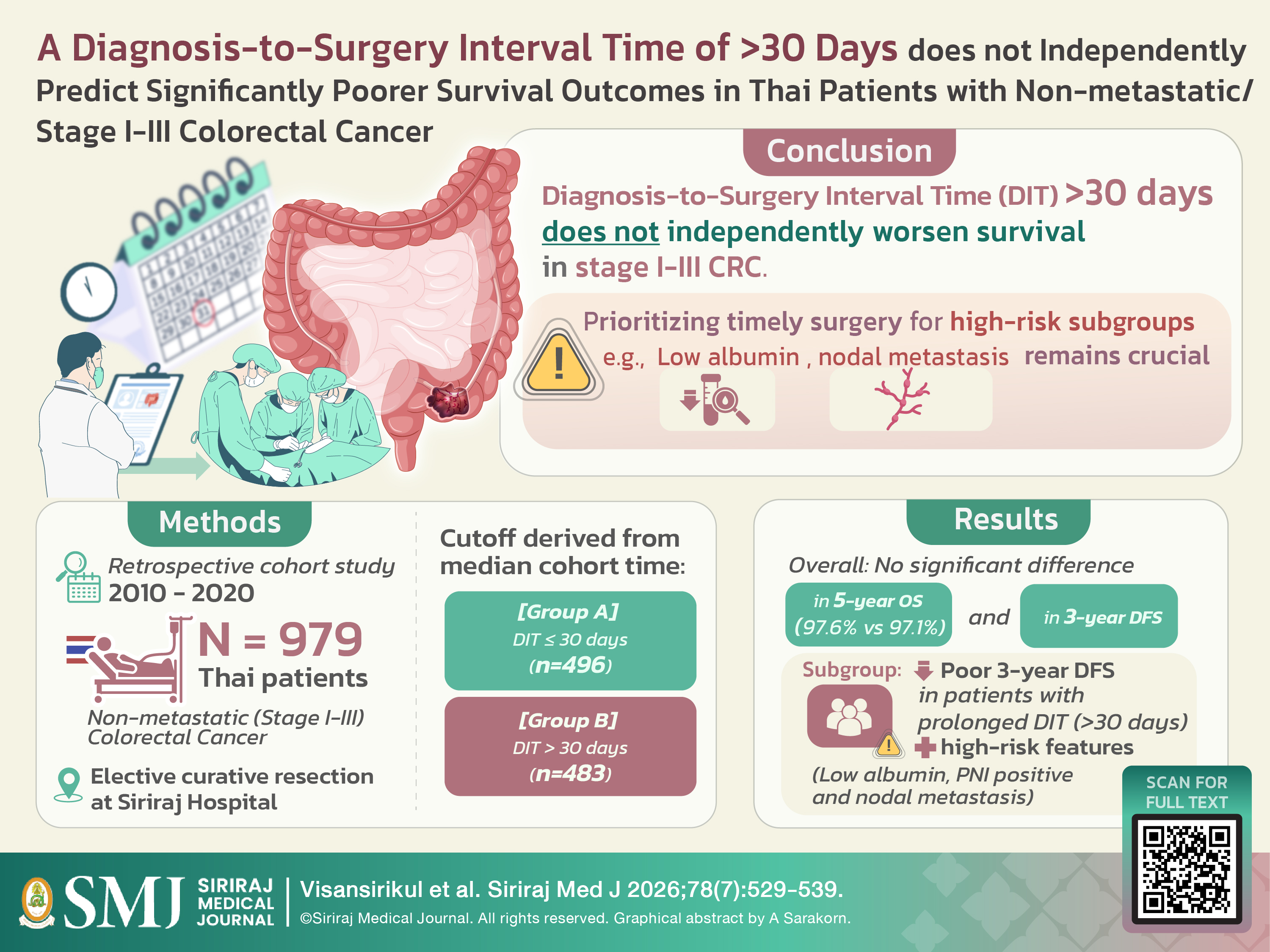
Objective: To identify the cutoff value for the optimal number of days to surgery, and to investigate the independent association between the diagnosis-to-surgery interval time (DIT) and survival outcome in Thai patients with nonmetastatic/stage I-III colorectal cancer.
Materials and Methods: A chart review of patients diagnosed with and operated upon for stage non-metastatic/stage I-III colorectal cancer at Siriraj Hospital (Bangkok, Thailand) during January 2010-December 2020 was conducted. The primary outcome was the survival rate compared between two different DITs. Multivariate regression was used to identify independent predictors of decreased survival.
Results: A total of 979 patients (median age: 65 years) were included. Of those, 18.4% had stage I, 38.6% had stage II, and 43.0% had stage III disease. The calculated median DIT of 30 days (IQR: 19-47) was used as the cutoff value to categorize patients into the ≤30-days or >30-days group. The 5-year overall survival rate was 97.6% and 97.1% (p=0.536), and the median survival time was 59.4 and 58.9 months - both respectively. The 3-year disease-free survival (DFS) rate was 86.9% and 85.7%, respectively (p=0.523). The independent predictors of decreased 3-year DFS among all patients were lymph node metastasis (p=0.037), adjuvant chemotherapy (p=0.005), and lymphovascular invasion (p=0.051). Further multivariate analysis in the DIT >30-days group found low preoperative albumin level (p=0.035), perineural invasion (p=0.011), and adjuvant chemotherapy (p<0.001) to independently predict significantly poorer 3-year DFS.
Conclusions: A DIT >30 days was not found to independently predict significantly poorer survival outcomes in Thai patients with non-metastatic/stage I-III colorectal cancer.
References
Imsamran W, Pattatang A, Supaattagorn P, Chaiwiriyabunya I, Namthaisong K, Wongsena M, et al. Cancer in Thailand: Vol. IX, 2013-2015. Bangkok (Thailand): New Thammada Press; 2018. 186 p.
National Comprehensive Cancer Network. Colon Cancer (Version 4.2020) [Available from: https://www.nccn.org/professionals/physician_gls/pdf/colon.pdf.
Zarcos-Pedrinaci I, Fernández-López A, Téllez T, Rivas-Ruiz F, Rueda A, Morales Suarez-Varela MM, et al. Factors that influence treatment delay in patients with colorectal cancer. Oncotarget. 2017;8(22):36728-42.
Lohsiriwat V, Chaisomboon N, Pattana-Arun J. Current Colorectal Cancer in Thailand. Ann Coloproctol. 2020;36(2):78-82.
Helewa RM, Turner D, Park J, Wirtzfeld D, Czaykowski P, Hochman D, et al. Longer waiting times for patients undergoing colorectal cancer surgery are not associated with decreased survival. J Surg Oncol. 2013;108(6):378-84.
Flemming JA, Nanji S, Wei X, Webber C, Groome P, Booth CM. Association between the time to surgery and survival among patients with colon cancer: A population-based study. Eur J Surg Oncol. 2017;43(8):1447-55.
Wanis KN, Patel SVB, Brackstone M. Do Moderate Surgical Treatment Delays Influence Survival in Colon Cancer? Dis Colon Rectum. 2017;60(12):1241-9.
Hangaard Hansen C, Gogenur M, Tvilling Madsen M, Gogenur I. The effect of time from diagnosis to surgery on oncological outcomes in patients undergoing surgery for colon cancer: A systematic review. Eur J Surg Oncol. 2018;44(10):1479-85.
Bagaria SP, Heckman MG, Diehl NN, Parker A, Wasif N. Delay to Colectomy and Survival for Patients Diagnosed with Colon Cancer. J Invest Surg. 2019;32(4):350-7.
Lino-Silva LS, Guzman-Lopez JC, Zepeda-Najar C, Salcedo-Hernandez RA, Meneses-Garcia A. Overall survival of patients with colon cancer and a prolonged time to surgery. J Surg Oncol. 2019;119(4):503-9.
Trepanier M, Paradis T, Kouyoumdjian A, Dumitra T, Charlebois P, Stein BS, et al. The Impact of Delays to Definitive Surgical Care on Survival in Colorectal Cancer Patients. J Gastrointest Surg. 2020;24(1):115-22.
Lee YH, Kung PT, Wang YH, Kuo WY, Kao SL, Tsai WC. Effect of length of time from diagnosis to treatment on colorectal cancer survival: A population-based study. PLoS One. 2019;14(1):e0210465.
Grass F, Behm KT, Duchalais E, Crippa J, Spears GM, Harmsen WS, et al. Impact of delay to surgery on survival in stage I-III colon cancer. Eur J Surg Oncol. 2020;46(3):455-61.
Redaniel MT, Martin RM, Blazeby JM, Wade J, Jeffreys M. The association of time between diagnosis and major resection with poorer colorectal cancer survival: a retrospective cohort study. BMC Cancer. 2014;14:642.
Roder D, Karapetis CS, Olver I, Keefe D, Padbury R, Moore J, et al. Time from diagnosis to treatment of colorectal cancer in a South Australian clinical registry cohort: how it varies and relates to survival. BMJ Open. 2019;9(9):e031421.
Kucejko RJ, Holleran TJ, Stein DE, Poggio JL. How Soon Should Patients With Colon Cancer Undergo Definitive Resection? Dis Colon Rectum. 2020;63(2):172-82.
Laird AK. Dynamics of tumor growth. Br J Cancer. 1964;13(3):490–502.
Sud A, Jones ME, Broggio J, Loveday C, Torr B, Garrett A, et al. Collateral damage: the impact on outcomes from cancer surgery of the COVID-19 pandemic. Ann Oncol. 2020;31(8):1065–74.
Tangkullayanone W, Vorasan N, Chaiboonchoe A, Trakarnsanga A, Tanjak P, Suwatthanarak T, et al. Combining Histopathologic and Gene-Expression Profiling for Risk Stratification of Nodal Metastasis in Colorectal Cancer. Siriraj Med J. 2026;78(2):152-63.
Tawantanakorn T, Akaraviputh T, Chinswangwatanakul V, Ithimakin S, Petsuksiri J, Trakarnsanga A. Pathological and Oncologic Outcomes of Consolidation Chemotherapy in Locally Advanced Rectal Cancer after Neoadjuvant Chemoradiation. Siriraj Med J. 2023;75(4):282-9.
Published
How to Cite
License
Copyright (c) 2026 Siriraj Medical Journal

This work is licensed under a Creative Commons Attribution-NonCommercial-NoDerivatives 4.0 International License.
Authors who publish with this journal agree to the following conditions:
Copyright Transfer
In submitting a manuscript, the authors acknowledge that the work will become the copyrighted property of Siriraj Medical Journal upon publication.
License
Articles are licensed under a Creative Commons Attribution-NonCommercial-NoDerivatives 4.0 International License (CC BY-NC-ND 4.0). This license allows for the sharing of the work for non-commercial purposes with proper attribution to the authors and the journal. However, it does not permit modifications or the creation of derivative works.
Sharing and Access
Authors are encouraged to share their article on their personal or institutional websites and through other non-commercial platforms. Doing so can increase readership and citations.