
A Novel Constipation Prevention and Management Protocol Versus Physician-Directed Management of Constipation in Critically Ill Cardiac Patients: A Randomized Controlled Study
DOI:
https://doi.org/10.33192/smj.v78i6.280566Keywords:
clinical protocols, defecation behavior, heart diseases, intensive care unit, laxativeAbstract
Objective: To compare the efficacy of a novel constipation prevention and management protocol with that of routine physician-directed management of constipation in critically ill cardiac patients.
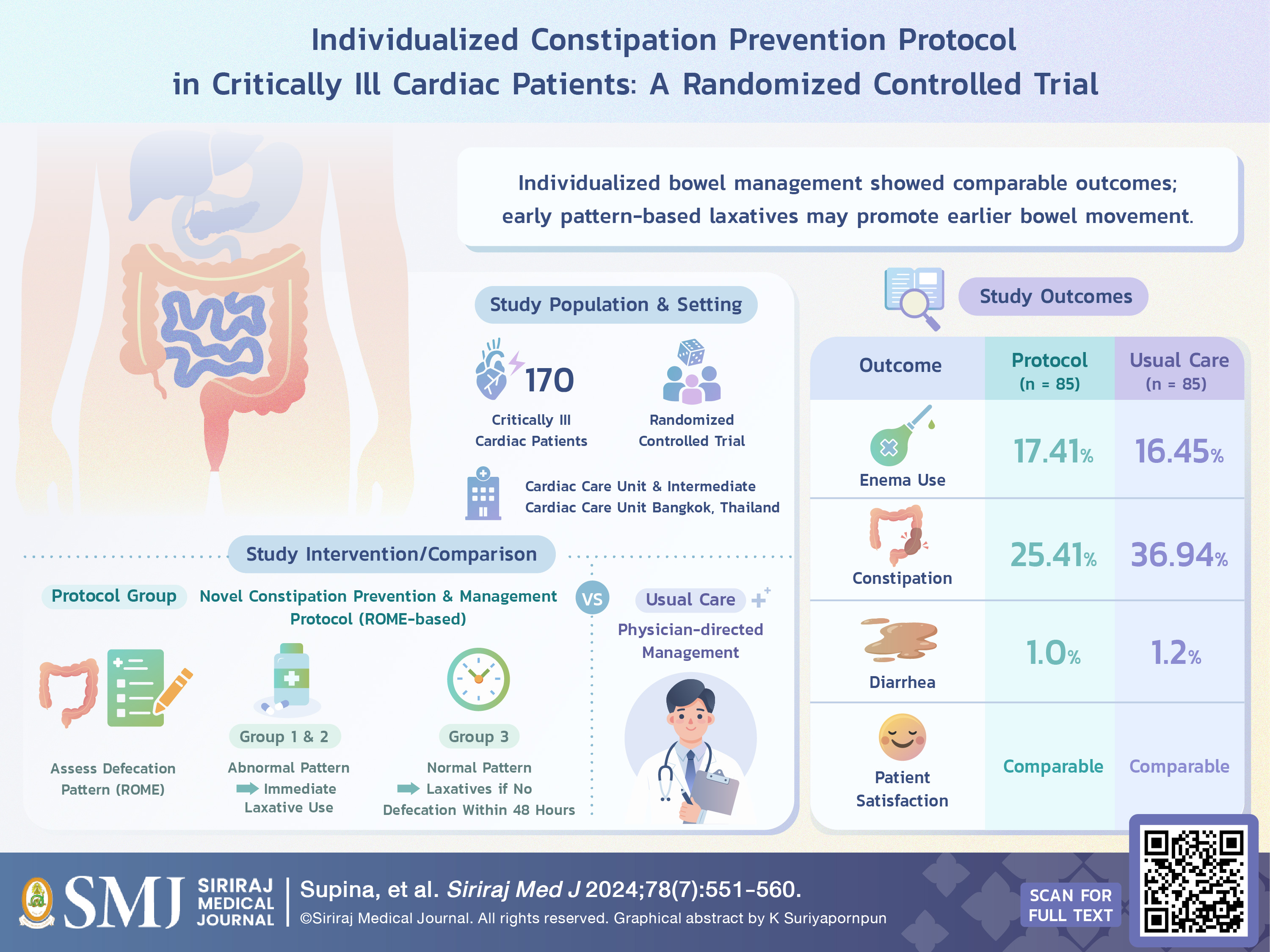
Materials and Methods: This randomized controlled trial was conducted in the cardiac care unit and intermediate cardiac care unit of a tertiary hospital in Bangkok, Thailand. A total of 170 patients were randomized and analyzed according to the intention-to-treat principle. Missing outcome data were handled using multiple imputation. The protocol group was further subdivided using the ROME criteria into Group 1 and Group 2 (abnormal patterns; received immediate laxatives) and Group 3 (normal pattern; received laxatives only if no defecation occurred within 48 hours). The primary outcome was enema use. Secondary outcomes included the incidence of constipation and diarrhea, and patient satisfaction. Data were analyzed using appropriate statistical methods.
Results: The incidence of enema use was 17.41% in the protocol group and 16.45% in the usual care group. Constipation occurred in 25.41% and 36.94% of patients, respectively, while diarrhea occurred in 1.0% and 1.2%. Patient satisfaction was comparable between groups (p = 0.221).
Conclusion: The individualized bowel management protocol did not significantly reduce enema use, constipation, or diarrhea compared with usual care. Exploratory findings suggest that early laxative administration based on defecation patterns may facilitate earlier bowel movement.
References
Batassini É, Beghetto MG. Constipation in a cohort prospective in adult critically ill patients: How much occurs and why?. Enfermeria Intensiva. 2019;30(3):127-34.
de Guerra TSL, Marshall NG, Mendonça SS. Constipation in Intensive Care. In: Rajendram R, Preedy VR, Patel VB, editors. Diet and Nutrition in Critical Care. New York, NY: Springer New York; 2015. p. 235-48.
Özdemir Ş, Akman Yılmaz A, Özdemir E. The Incidence, Risk Factors, and Effects of Constipation in Critical Patients: An Observational Cross-sectional Study. Mediterr Nurs Midwifery. 2024;4(1):44-53.
Prat D, Messika J, Avenel A, Jacobs F, Fichet J, Lemeur M, et al. Constipation incidence and impact in medical critical care patients: importance of the definition criterion. Eur J Gastroenterol Hepatol. 2016;28(3):290-6.
Putwatana P, Sanrung P, Budpanya W. Constipation, management, and clinical outcomes in critically ill surgical patients. Thai Journal of Nursing. 2012;61(3):60-8.
Ali H, Pamarthy R, Manickam S, Sarfraz S, Sahebazamani M, Movahed H. Effect of constipation on outcomes in mechanically ventilated patients. Proc (Bayl Univ Med Cent). 2022;35(3):284-90.
Fukuda S, Miyauchi T, Fujita M, Oda Y, Todani M, Kawamura Y, et al. Risk factors for late defecation and its association with the outcomes of critically ill patients: a retrospective observational study. J Intensive Care. 2016;4:33.
Ishiyama Y, Hoshide S, Mizuno H, Kario K. Constipation-induced pressor effects as triggers for cardiovascular events. J Clin Hypertens (Greenwich). 2019;21(3):421-5.
Soheilipour M, Goudarzinejad E, Tabesh E. Efficacy of non-pharmacological treatment for adult patients with chronic constipation. Int J Physiol Pathophysiol Pharmacol. 2022;14(4):247-53.
Fennessy GJ, Warrillow SJ. Gastrointestinal problems in intensive care. Anaesthesia & Intensive Care Medicine. 2015;16(4):165-70.
Yamamoto J, Yamamoto M, Hara H, Hiroi Y. Relation between laxative use and risk of major bleeding in patients with atrial fibrillation and heart failure. Heart Vessels. 2023;38(7):938-48.
Warren D, Kent B. Determining the impact of a bowel management protocol on patients and clinicians' compliance in cardiac intensive care: A mixed-methods approach. J Clin Nurs. 2019;28(1-2):89-103.
Knowles S, McInnes E, Elliott D, Hardy J, Middleton S. Evaluation of the implementation of a bowel management protocol in intensive care: effect on clinician practices and patient outcomes. J Clin Nurs. 2014;23(5-6):716-30.
Guardiola B, Llompart-Pou JA, Ibáñez J, Raurich JM. Prophylaxis Versus Treatment Use of Laxative for Paralysis of Lower Gastrointestinal Tract in Critically Ill Patients. J Clin Gastroenterol. 2016;50(2):e13–8.
Tirlapur N, Puthucheary ZA, Cooper JA, Sanders J, Coen PG, Moonesinghe SR, et al. Diarrhoea in the critically ill is common, associated with poor outcome, and rarely due to Clostridium difficile. Sci Rep. 2016;6:24691.
Nishitani-Yokoyama M, Shimada K, Yamada M, Honzawa A, Kunimoto M, Sugita Y, et al. Association Between Constipation and Frailty Components in Patients Undergoing Late Phase II Cardiac Rehabilitation. Cardiol Res. 2021;12(3):169-76.
Chuamor K, Thongdonjuy J.Effectiveness of standard nursing care with gum chewing to reduce bowel ileus in post-operative gynecologic patients: randomized controlled trial. Siriraj Med J. 2014;66(2):49-54.
Siripohn P, Visavajarn P, Suwannatrai U, Suwannatrai S, Butdapan P, Ruangchainikom M. The effects of the Thai traditional medicine of abdominal massage on defecation in post-lumbar laminectomy patients. Siriraj Med J. 2019;71(3):214-9.
Li H, Peng B. Effect of comfort-oriented intervention combined with medical sponge positioning cushion on treatment compliance and psychological status of patients undergoing side-lying enema operation: A retrospective study. Medicine (Baltimore). 2025;104(15):e41717.
Lin JN, Xie WT, Yang YY, Wu CH, Wang JJ. Living with constipation and communication taboos surrounding constipation among older adults: An interpretive phenomenology analysis study. Geriatr Nurs. 2024;58:266-73.
Published
How to Cite
License
Copyright (c) 2026 Siriraj Medical Journal

This work is licensed under a Creative Commons Attribution-NonCommercial-NoDerivatives 4.0 International License.
Authors who publish with this journal agree to the following conditions:
Copyright Transfer
In submitting a manuscript, the authors acknowledge that the work will become the copyrighted property of Siriraj Medical Journal upon publication.
License
Articles are licensed under a Creative Commons Attribution-NonCommercial-NoDerivatives 4.0 International License (CC BY-NC-ND 4.0). This license allows for the sharing of the work for non-commercial purposes with proper attribution to the authors and the journal. However, it does not permit modifications or the creation of derivative works.
Sharing and Access
Authors are encouraged to share their article on their personal or institutional websites and through other non-commercial platforms. Doing so can increase readership and citations.