
Effects of a Home-Based Fall Prevention Program in Older Lower Limb Prosthesis Users: A Randomized Controlled Trial
DOI:
https://doi.org/10.33192/smj.v78i10.283047Keywords:
Fall prevention, older adult, amputee, lower limb, prosthesisAbstract
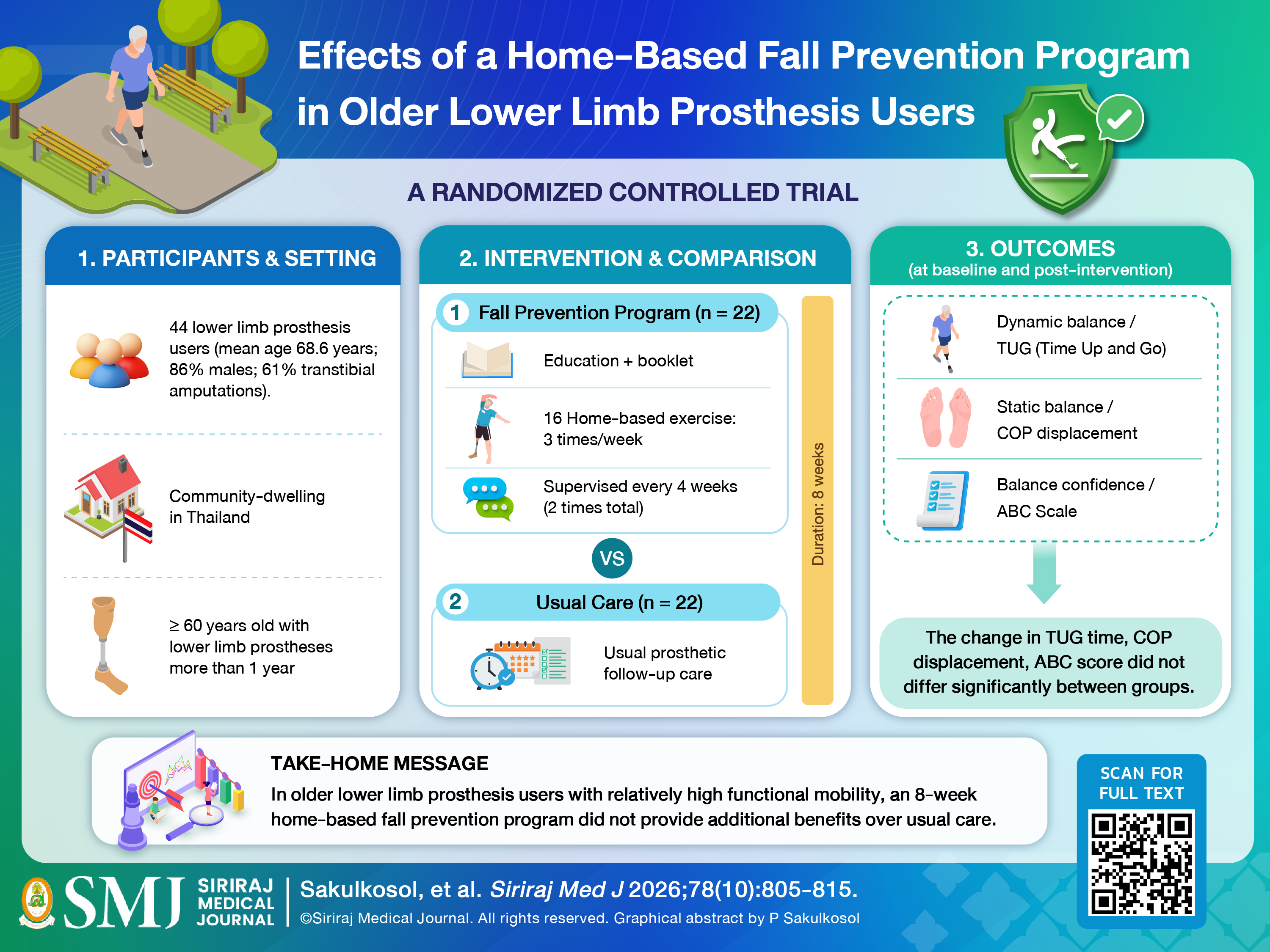
Objective: To analyze the effects of a home-based fall prevention program on dynamic and static balance and balance confidence in older lower limb prosthesis (LLP) users.
Materials and Methods: In this randomized controlled trial, 44 older LLP users were randomly assigned to either a control group receiving usual care or an intervention group receiving a fall prevention program consisting of education and 16 home-based exercises performed three times per week for eight weeks. Dynamic balance was measured using the Timed Up and Go (TUG) test, static balance using center of pressure displacement, and balance confidence using the Activities-specific Balance Confidence scale. Outcomes were assessed at baseline and post-intervention.
Results: Forty-one of 44 randomized participants completed the study. Among the 44 randomized participants, the mean age was 68.6 ± 6.7 years; 86% were male; 61% had transtibial amputations; 66% had traumatic amputation. The change in TUG time did not differ significantly between groups (median (inter-quartile range) change: −0.6 (−1.5, 0.4) seconds in the intervention group and −0.4 (−1.2, 0.3) seconds in the control group; p = 0.584, r = 0.09). No significant between-group differences were observed in static balance or balance confidence. No falls were reported during the study.
Conclusion: A combined fall prevention education and eight-week home-based exercise program did not result in significantly greater improvements than usual care in dynamic balance, static balance, or balance confidence among older LLP users with relatively high functional mobility. The findings should be interpreted with consideration of the unblinded outcome assessment.
References
Kanade R, Van Deursen RWM, Harding KG, Price PE. Investigation of standing balance in patients with diabetic neuropathy at different stages of foot complications. Clin Biomech. 2008;23(9):1183–91.
Buckley JG, O’Driscoll D, Bennett SJ. Postural sway and active balance performance in highly active lower-limb amputees. Am J Phys Med Rehabil. 2002;81(1):13–20.
Schafer ZA, Perry JL, Vanicek N. A personalised exercise programme for individuals with lower limb amputation reduces falls and improves gait biomechanics: a block randomised controlled trial. Gait Posture. 2018;63:282–9.
Hunter SW, Batchelor F, Hill KD, Hill AM, Mackintosh S, Payne M. Risk factors for falls in people with a lower limb amputation: a systematic review. PM R. 2017;9(2):170–80.e1.
Lewallen R, Johnson E Jr. Fractures in amputation stumps: review of treatment of 16 fractures. In: Mayo Clinic Proceedings; 1981.
Kulkarni J, Wright S, Toole C, Morris J, Hirons R. Falls in patients with lower limb amputations: prevalence and contributing factors. Physiotherapy. 1996;82(2):130–6.
Behar T, Burnham S, Johnson G Jr. Major stump trauma following below-knee amputation. Outcome and recommendations for therapy. J Cardiovasc Surg. 1991;32(6):753–6.
Mundell B, Maradit Kremers H, Visscher S, Hoppe K, Kaufman K. Direct medical costs of accidental falls for adults with transfemoral amputations. Prosthet Orthot Int. 2017;41(6):564–70.
Miller WC, Deathe AB, Speechley M, Koval J. The influence of falling, fear of falling, and balance confidence on prosthetic mobility and social activity among individuals with a lower extremity amputation. Arch Phys Med Rehabil. 2001;82(9):1238–44.
Miller WC, Speechley M, Deathe B. The prevalence and risk factors of falling and fear of falling among lower extremity amputees. Arch Phys Med Rehabil. 2001;82(8):1031–7.
Clemens S, Doerger C, Lee SP. Current and emerging trends in the management of fall risk in people with lower limb amputation. Curr Geriatr Rep. 2020;9(3):134–41.
Chang S, Yan JX, Mu L. Effects of exercise on physical performance and quality of life in individuals with limb amputation: a systematic review and meta-analysis. BMC Musculoskelet Disord. 2025;26(1):965.
Ong MF, Soh KL, Saimon R, Wai MW, Mortell M, Soh KG. Fall prevention education to reduce fall risk among community-dwelling older persons: a systematic review. J Nurs Manag. 2021;29(8):2674-88.
World Health Organization. WHO global report on falls prevention in older age. Geneva: World Health Organization; 2008.
McDonough CM, Harris-Hayes M, Kristensen MT, Overgaard JA, Herring TB, Kenny AM, et al. Physical therapy management of older adults with hip fracture. J Orthop Sports Phys Ther. 2021;51(2):1–81.
Klute GK, Berge JS, Orendurff MS, Williams RM, Czerniecki JM. Prosthetic intervention effects on activity of lower-extremity amputees. Arch Phys Med Rehabil. 2006;87(5):717–22.
Nasreddine ZS, Phillips NA, Bédirian V, Charbonneau S, Whitehead V, Collin I, et al. The Montreal Cognitive Assessment, MoCA: a brief screening tool for mild cognitive impairment. J Am Geriatr Soc. 2005;53(4):695–9.
Sakulkosol P, Dijkstra PU, Sasaki K, Guerra G, Poonsiri J. Development and evaluation of a patient education booklet on fall prevention exercises for older lower limb prosthesis users. Siriraj Med J. 2026;78(2):87–95.
Campbell AJ, Robertson MC, Gardner MM, Norton RN, Tilyard MW, Buchner DM. Randomised controlled trial of a general practice programme of home based exercise to prevent falls in elderly women. BMJ. 1997;315(7115):1065–9.
Simek EM, McPhate L, Haines TP. Adherence to and efficacy of home exercise programs to prevent falls: a systematic review and meta-analysis of the impact of exercise program characteristics. Prev Med. 2012;55(4):262–75.
Mangano GR, Valle MS, Casabona A, Vagnini A, Cioni M. Age-related changes in mobility evaluated by the timed up and go test instrumented through a single sensor. Sensors. 2020;20(3):719.
Podsiadlo D, Richardson S. The timed “Up & Go”: a test of basic functional mobility for frail elderly persons. J Am Geriatr Soc. 1991;39(2):142–8.
Shumway-Cook A, Brauer S, Woollacott M. Predicting the probability for falls in community-dwelling older adults using the Timed Up & Go Test. Phys Ther. 2000;80(9):896–903.
Dite W, Connor HJ, Curtis HC. Clinical identification of multiple fall risk early after unilateral transtibial amputation. Arch Phys Med Rehabil. 2007;88(1):109–14.
Falivene A, Scaccabarozzi G, Busti Ceccarelli S, Molteni M, Klingels K, Verbecque E, et al. Virtual reality-based postural balance training in autistic children: a pilot randomized controlled trial. J Clin Med. 2025;14(16):5616.
Quijoux F, Vienne-Jumeau A, Bertin-Hugault F, Zawieja P, Lefevre M, Vidal PP, et al. Center of pressure displacement characteristics differentiate fall risk in older people: a systematic review with meta-analysis. Ageing Res Rev. 2020;62:101117.
Tjernström F, Björklund M, Malmström EM. Romberg ratio in quiet stance posturography—test to retest reliability. Gait Posture. 2015;42(1):27–31.
Lajoie Y, Gallagher S. Predicting falls within the elderly community: comparison of postural sway, reaction time, the Berg Balance Scale and the Activities-specific Balance Confidence (ABC) scale for comparing fallers and non-fallers. Arch Gerontol Geriatr. 2004;38(1):11–26.
Powell LE, Myers AM. The activities-specific balance confidence (ABC) scale. J Gerontol A Biol Sci Med Sci. 1995;50A(1):M28-34.
Khumpaneid N, Phoka T, Khongprasert S. Effects of modified-Otago exercise program on four components of actual balance and perceived balance in healthy older adults. Geriatrics. 2022;7(5):88.
Fortington LV, Rommers GM, Geertzen JH, Postema K, Dijkstra PU. Mobility in elderly people with a lower limb amputation: a systematic review. J Am Med Dir Assoc. 2012;13(4):319–25.
Montero-Odasso M, Van Der Velde N, Martin FC, Petrovic M, Tan MP, Ryg J, et al. World guidelines for falls prevention and management for older adults: a global initiative. Age and ageing. 2022 Sep;51(9):afac205.
Wijekoon A, Jayawardana S, Milton-Cole R, Chandrathilaka M, Jones A, Cook S, et al. Effectiveness and equity in community-based rehabilitation on pain, physical function, and quality of life after unilateral lower limb amputation: a systematic review. Arch Phys Med Rehabil. 2023;104(9):1484–97.
Godlwana L, Stewart A, Musenge E. The effect of a home exercise intervention on persons with lower limb amputations: a randomized controlled trial. Clin Rehabil. 2020;34(1):99–110.
Pinzur MS, Cox W, Kaiser J, Morris T, Patwardhan A, Vrbos L. The effect of prosthetic alignment on relative limb loading in persons with trans-tibial amputation: a preliminary report. J Rehabil Res Dev. 1995;32(4):373–7.
Arifin N, Abu Osman NA, Ali S, Gholizadeh H, Wan Abas WAB. Postural stability characteristics of transtibial amputees wearing different prosthetic foot types when standing on various support surfaces. Sci World J. 2014;2014:856279.
Van Velzen J, van Bennekom CA, Polomski W, Slootman J, van der Woude LH, Houdijk H. Physical capacity and walking ability after lower limb amputation: a systematic review. Clin Rehabil. 2006;20(11):999–1016.
Wong CK, Gibbs WB. Factors associated with committed participation in a wellness-walking program for people with lower limb loss: a prospective cohort study. Prosthet Orthot Int. 2019;43(2):180–7.
Published
How to Cite
Issue
Section
Categories
License
Copyright (c) 2026 Siriraj Medical Journal

This work is licensed under a Creative Commons Attribution-NonCommercial-NoDerivatives 4.0 International License.
Authors who publish with this journal agree to the following conditions:
Copyright Transfer
In submitting a manuscript, the authors acknowledge that the work will become the copyrighted property of Siriraj Medical Journal upon publication.
License
Articles are licensed under a Creative Commons Attribution-NonCommercial-NoDerivatives 4.0 International License (CC BY-NC-ND 4.0). This license allows for the sharing of the work for non-commercial purposes with proper attribution to the authors and the journal. However, it does not permit modifications or the creation of derivative works.
Sharing and Access
Authors are encouraged to share their article on their personal or institutional websites and through other non-commercial platforms. Doing so can increase readership and citations.