
Restoring Culturally Essential Floor-Sitting in Transfemoral Prosthesis Users: A Six-Week Pilot Randomized Within-Subject Trial
DOI:
https://doi.org/10.33192/smj.v78i10.283845Keywords:
transfemoral prosthesis, socket design, floor-sitting, quality of life, resource-limited settingAbstract
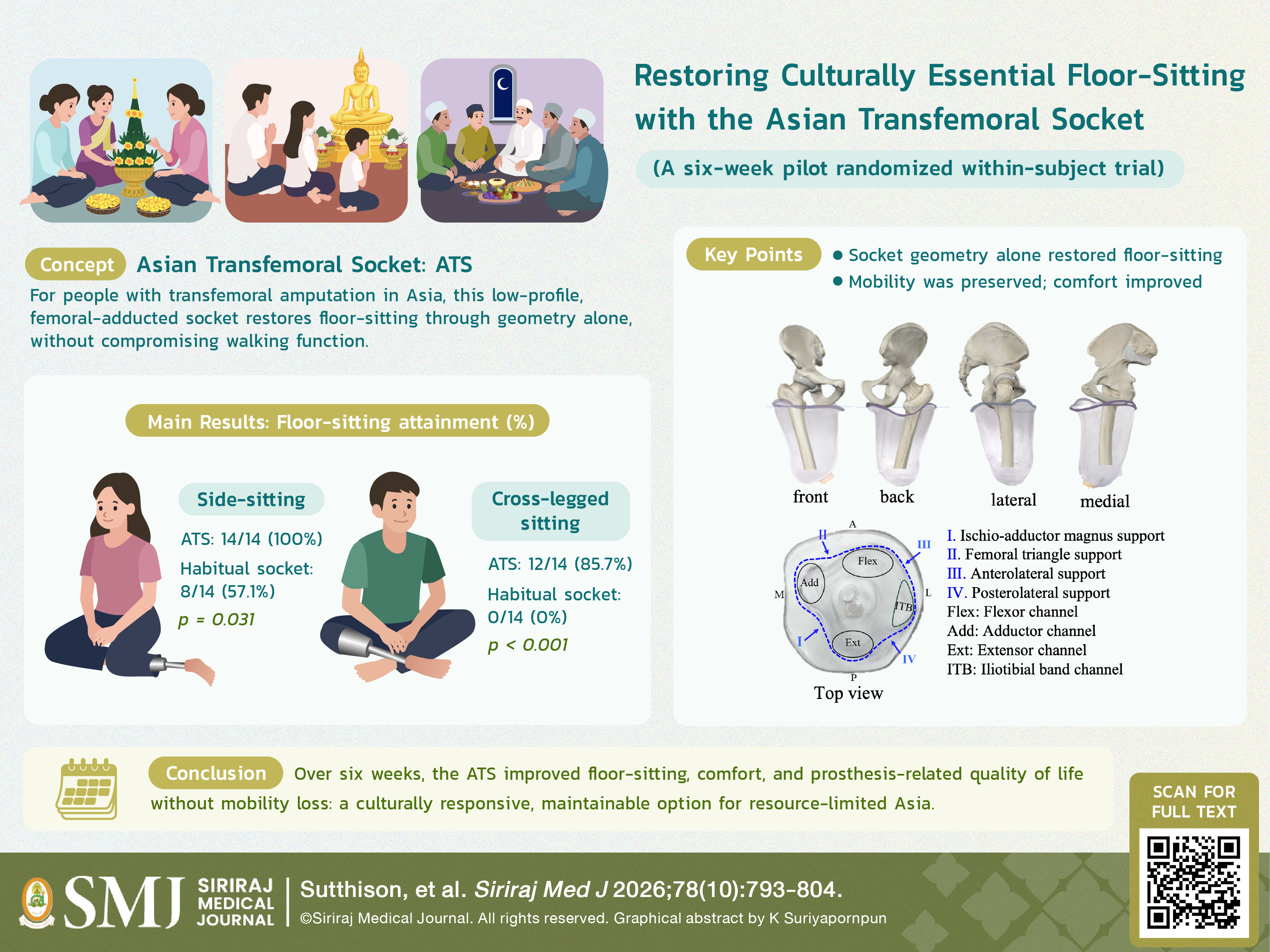
Objective: Floor-sitting, including cross-legged and side-sitting, is culturally essential in many Asian societies but is often prevented by conventional transfemoral sockets. The Asian Transfemoral Socket (ATS) is a low-profile, femoraladducted design that aims to restore floor-sitting through socket geometry rather than costly add-on components.
Materials and Methods: In a pilot randomized within-subject trial, 14 community walkers with unilateral transfemoral amputation were assessed with the ATS after six weeks of use and with their own socket, in randomized order. The primary outcome was floor-sitting attainment (cross-legged and side-sitting); secondary outcomes were socket comfort (SCS), prosthesis-related quality of life (PEQ), walking capacity (6MWT), dynamic balance (4SST), and daily step count. Outcomes were analyzed using Wilcoxon signed-rank and McNemar tests, with rank-biserial correlations as effect sizes.
Results: Cross-legged was attained by 12 participants with the ATS (p < 0.001) and side-sitting by 6 additional participants (p = 0.031). The ATS showed large effect sizes on comfort and quality of life, significant on two of four SCS ratings and two of three PEQ scales, whereas walking, balance, and activity did not differ (6MWT r = 0.09; 4SST r = 0.29; steps r = -0.05).
Conclusion: The ATS was associated with better floor-sitting and patient-reported outcomes. No statistically supported mobility difference was detected (paired median differences: 6MWT +0.4 m [95% CI -3.5 to 11.3], 4SST -0.21 s [-0.44 to 0.21], steps/day -23 [-449 to 521]); clinically important harm cannot be excluded. Cost, fabrication time, training, maintenance, and service delivery were not evaluated; findings are limited to this Thai center.
References
Hewes GW. World distribution of certain postural habits. Am Anthropol. 1955;57(2):231–44.
Kapoor A, Mishra SK, Dewangan SK, Mody BS. Range of movements of lower limb joints in cross-legged sitting posture. J Arthroplasty. 2008;23(3):451–3.
Zhou H, Liu A, Wang D, Zeng X, Wei S, Wang C. Kinematics of lower limbs of healthy Chinese people sitting cross-legged. Prosthet Orthot Int. 2013;37(5):369–74.
Ganokroj P, Chaowalitwong J, Kerdsomnuek P, et al. Three-dimensional motion analysis of ten common Asian sitting positions in daily living and factors affecting range of hip motions. BMC Musculoskelet Disord. 2021;22:618.
World Health Organization. International Classification of Functioning, Disability and Health: ICF. Geneva: World Health Organization; 2001.
Cavuto ML, Chun M, Kelsall N, et al. Design of mechanism and preliminary field validation of low-cost transfemoral rotator for use in the developing world. In: Proceedings of the ASME 2016 International Design Engineering Technical Conferences; 2016 Aug 21–24; Charlotte, NC, USA. V05AT07A035.
Horgan O, MacLachlan M. Psychosocial adjustment to lower-limb amputation: a review. Disabil Rehabil. 2004;26(14–15):837–50.
Brodie M, Murray L, McGarry A. Transfemoral prosthetic socket designs: A review of the literature. J Prosthet Orthot. 2022;34(2):e73–e92.
Radcliffe CW. Functional considerations in the fitting of above-knee prostheses. Berkeley (CA): Biomechanics Laboratory, University of California; 1955.
Sabolich J. Contoured adducted trochanteric-controlled alignment method (CAT-CAM): Introduction and basic principles. Clin Prosthet Orthot. 1985;9(4):15–26.
Hagberg K, Häggström E, Uden M, Brånemark R. Socket versus bone-anchored transfemoral prostheses: Hip range of motion and sitting comfort. Prosthet Orthot Int. 2005;29(2):153–63.
Klotz R, Colobert B, Botino M, Permentiers I. Influence of different types of sockets on the range of motion of the hip joint by the transfemoral amputee. Ann Phys Rehabil Med. 2011;54(7):399–410.
Harkins CS, McGarry A, Buis A. Provision of prosthetic and orthotic services in low-income countries: A review of the literature. Prosthet Orthot Int. 2013;37(5):353–61.
Craig J. Prosthetic feet for low-income countries. J Prosthet Orthot. 2005;17(Suppl):S47–S49.
Gusev MG, Lein GA, Alzoba SV. Advantages of the Marlo anatomical socket (MAS) for transfemoral prosthesis. Genij Ortopedii. 2020;26(3):359–63.
Fatone S, Caldwell R. Northwestern University Flexible Subischial Vacuum Socket for persons with transfemoral amputation–Part 1: Description of technique. Prosthet Orthot Int. 2017;41(3):237–45.
Fatone S, Caldwell R. Northwestern University Flexible Subischial Vacuum Socket for persons with transfemoral amputation–Part 2: Description and preliminary evaluation. Prosthet Orthot Int. 2017;41(3):246–50.
Köhler TM, Blumentritt S, Braatz F, Bellmann M. The impact of transfemoral socket adduction on pelvic and trunk stabilization during level walking–a biomechanical study. Gait Posture. 2021;89:169–77.
Schuch CM. Modern above-knee fitting practice (a report on the ISPO workshop on above-knee fitting and alignment techniques, May 15–19, 1987, Miami, USA). Prosthet Orthot Int. 1988;12(2):77–90.
Tan JM, Halford GRJ, Lukin M, Kohler F. Recommendations from the ISPO lower-limb COMPASS: patient-reported and performance-based outcome measures. Prosthet Orthot Int. 2023;47(1):13–25.
Hanspal RS, Fisher K, Nieveen R. Prosthetic socket fit comfort score. Disabil Rehabil. 2003;25(22):1278–80.
Legro MW, Reiber GD, Smith DG, del Aguila M, Larsen J, Boone D. Prosthesis evaluation questionnaire for persons with lower limb amputations: Assessing prosthesis-related quality of life. Arch Phys Med Rehabil. 1998;79(8):931–8.
ATS Statement. Guidelines for the six-minute walk test. Am J Respir Crit Care Med. 2002;166(1):111–7.
Resnik L, Borgia M. Reliability of outcome measures for people with lower-limb amputations: distinguishing true change from statistical error. Phys Ther. 2011;91(4):555-65.
Balk EM, Gazula A, Markozannes G, Kimmel HJ, Saldanha IJ, Resnik LJ, et al. Lower limb prostheses: measurement instruments, comparison of component effects by subgroups, and long-term outcomes. Comparative Effectiveness Review No. 213. Rockville (MD): Agency for Healthcare Research and Quality; 2018. AHRQ Publication No. 18-EHC017-EF.
Dite W, Temple VA. A clinical test of stepping and change of direction to identify multiple falling older adults. Arch Phys Med Rehabil. 2002;83(11):1566–71.
Sawers A, Kim J, Balkman G, Hafner BJ. Interrater and test-retest reliability of performance-based clinical tests administered to established users of lower limb prostheses. Phys Ther. 2020;100(7):1206-16.
Dite W, Connor HJ, Curtis HC. Clinical identification of multiple fall risk early after
unilateral transtibial amputation. Arch Phys Med Rehabil. 2007;88(1):109-14.
Ramstrand N, Nilsson KA. Validation of a patient activity monitor to quantify ambulatory activity in an amputee population. Prosthet Orthot Int. 2007;31(2):157–66.
Whitehead AL, Julious SA, Cooper CL, Campbell MJ. Estimating the sample size for a pilot randomised trial to minimise the overall trial sample size for the external pilot and main trial for a continuous outcome variable. Stat Methods Med Res. 2016;25(3):1057–73.
Additional Files
Published
How to Cite
Issue
Section
Categories
License
Copyright (c) 2026 Siriraj Medical Journal

This work is licensed under a Creative Commons Attribution-NonCommercial-NoDerivatives 4.0 International License.
Authors who publish with this journal agree to the following conditions:
Copyright Transfer
In submitting a manuscript, the authors acknowledge that the work will become the copyrighted property of Siriraj Medical Journal upon publication.
License
Articles are licensed under a Creative Commons Attribution-NonCommercial-NoDerivatives 4.0 International License (CC BY-NC-ND 4.0). This license allows for the sharing of the work for non-commercial purposes with proper attribution to the authors and the journal. However, it does not permit modifications or the creation of derivative works.
Sharing and Access
Authors are encouraged to share their article on their personal or institutional websites and through other non-commercial platforms. Doing so can increase readership and citations.